It will probably come as no surprise to most of you that I am a fan of the Terminator 2 movie. How could you not love Big Arnie as a reformed cyber assassin riding a Harley Fat Boy and saving the world. The plot line regarding the machines becoming lethally self-aware is of course far-fetched and unbelievable. At least it was back in 1991 when the film was released. I suspect anything but far-fetched today.
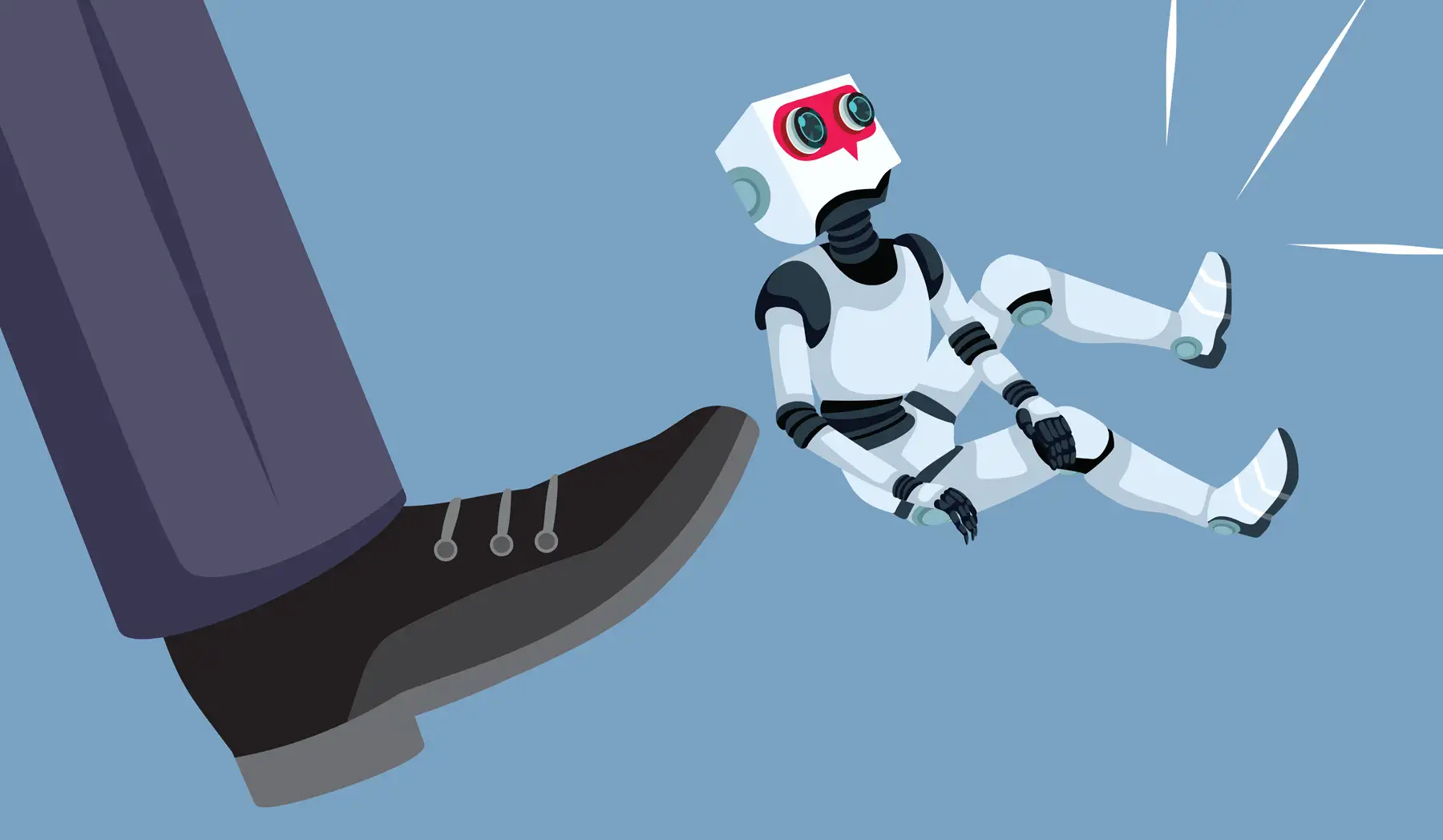
Recently we’ve been doing a Sarah Connor and looking into the evils or otherwise of Ai. In particular, how some form of adoption of this terrifying technology might streamline our processes. We’ve come to the conclusion that the Ai solutions currently available and appropriate to our business are unlikely to enhance the customer experience. The more likely outcome will be a dumbing down of staff skills combined with a client backlash as an automated process asks them to do our job for us.
According to the managing director the greatest risk is The Terminator factor. That is, the machines will figure out I’m not that smart and my tenuous grasp of finance will be revealed for what it is. We can’t have that.
I think we need to be honest about Ai. At its core, the adoption of this technology in business is mostly about money. Get a machine to do a job and that’s one less staff member you gotta pay. It has ever been thus. From the elevator operator to the auto manufacturing industry and the driverless dump trucks in mines, the impacts of automation and robotics are all around us. What about the poor old pin setter at the bowling alley or the switchboard operator. These jobs are gone not because automation does it better, they are gone because it’s cheaper. Well, maybe not in the case of the pin setter, but you get my point. And, if you can’t get a robot to do the job the next best thing is to send the gig offshore to some developing nation, where people live and work on subsistence wages. Again, it’s not because they are better, it’s because they are cheaper.
The challenge here is that as businesses move to automated customer interaction and process, service suffers, the customer does more work and the corporation doesn’t care. They say they do, but they don’t. This is particularly the case in *semi-monopoly situations such as supermarkets and banks. From self-serve checkouts to bank apps that ask us to do the work, to long wait periods at call centres and even longer queues at the local bank branch, the evidence is everywhere. Of course, there’s always one checkout isle open, and one teller on at the bank. That’s just a cynical façade to demonstrate how much better your life would be if you used self-serve or the app. Never mind that the poor bugger on the front line, who’s been used as cannon fodder, is about to have a nervous breakdown of course.
I wouldn’t mind if companies were honest about a desire to have less employees, save money and treat customers poorly. Instead, they cull staff, create customer dissatisfaction, and put up signs saying being angry won’t be tolerated. The geniuses who come up with this stuff appear not to appreciate that the anger they won’t tolerate is a direct outcome of the terrible service they provide. They disrespect their clients, and in doing so disrespect their staff. If we ever have to put up signs asking clients not to be mad at us, I suspect we’ll have a very serious problem.
When I’m on hold in a call queue, and I keep being told how important my call is and how wonderful the company, is I just laugh. Instead, can someone have the honesty to play me the following:
“Hi, we know you’ve been on hold your entire lunch hour but we’re not going to insult your intelligence by telling you how important you are. Frankly, we don’t give a sh*t and neither do any of our competitors, so good luck with that”.
Then, you finally get through and the operator says, “You know you can do this yourself on the app, can I send you a link.” Back in the day customer interactions were considered a positive opportunity to know clients better and sell them stuff. Now, it seems the customer is to be avoided at all costs. More like being avoided at no cost I guess.
All of this is not to say I don’t like modern tech…… when it works. I’m currently overseas and before I left, I had to advise the two banks I deal with that I might be using a credit card in a foreign land. Both have app functions to do so. One is seamless, one is cleverly hidden so even the call centre staff aren’t sure where it is. One took me 30 seconds, one took 30 minutes. Even more confronting, I can find nowhere that tracks and monitors the MD’s cards. She could be long gone with the pool man and the first I’d know would be a postcard from Geneva and algae in the pond.
I think the traps of rushing headlong into any sort of automation are many. My observation would be that a lot of businesses are looking inwardly rather than starting with a customer focus. The travel and accommodation sector is no exception. Will the leisure traveller ever really bond with a robot on the front desk? Will the regional motel patron be happy that the property isn’t staffed and the couple next door are doing the wild thing at 2am. When phoning a property, will the experience feel special and bespoke when the customer is confronted with the Press 1 for existing, 2 for new, 3 for… blah blah blah.
For us I suspect we won’t be able to halt the tide of tech, and the service delivery to costs challenge will continue to evolve. However, right now staying mostly analogue in a digital world might be an expensive business model but we’re sticking with it. With everyone rushing headlong into the brave new world of Ai, real human service might be the last great differentiator. I guess we’ll find out.
I’ll leave you with this spectacular example of how companies think. We (the MD and I) do business with a company that has been acquired by a much larger operator. The larger is listed on the ASX, the smaller was. The automated generic message being sent to customers of the smaller institution tells us we will soon be customers of the larger and the products we currently use will be replaced by the acquirers’ offerings. No detail on those offerings. The arrogance of the assumptions in this messaging is breathtaking. I’d suggest an invitation goes down way better than an order. There’s an old adage about taking the customer with you. It’s certainly true, but perhaps not with handcuffs and a blindfold. Let’s leave that for weekends away.
BTW… thanks to my friend Paul Grant I am addicted to playing with Ai apps to see what house renovations and vehicle modifications might look like. I showed one app to the MD who did that most predictable of things. She uploaded a photo of herself and began facelift modelling. You can’t improve a masterpiece I told her. Dodged that bullet beautifully I thought.
*Yes, I know a semi-monopoly is an oligopoly. I was just trying to avoid coming across like I knew what I was talking about.
Mike Phipps F Fin
Director | Phippsfin Pty Ltd
No AI or ChatGPT has been used in the writing of this article.